
What is a DOT Safety Rating? Understanding Motorcycle Helmet Certification
Table of Contents:
Every time you get on your motorcycle, your helmet becomes the most important piece of safety equipment you own. But how do you know if it provides proper protection? That's where DOT safety ratings come in.
Understanding DOT Safety Ratings for Motorcycle Helmets
A DOT safety rating is an evaluation system created by the Department of Transportation that assesses how well protective headgear meets federal safety standards. These safety ratings help identify helmets that provide adequate protection for riders. The DOT certification system verifies that motorcycle helmets meet requirements set forth in Federal Motor Vehicle Safety Standard (FMVSS) 218.
Think of a DOT safety rating as a seal of approval for motorcycle helmets. It shows whether a helmet meets the safety fitness standard when it comes to protecting your head during a crash. This certification isn't optional—it's a legal requirement for all helmets sold for use on public roads in the United States.
The Federal Motor Carrier Safety Administration oversees many transportation safety regulations, but the National Highway Traffic Safety Administration (NHTSA) handles helmet safety ratings. This regulatory compliance ensures consistent safety standards across the industry.
The DOT Safety Rating System for Motorcycle Helmets
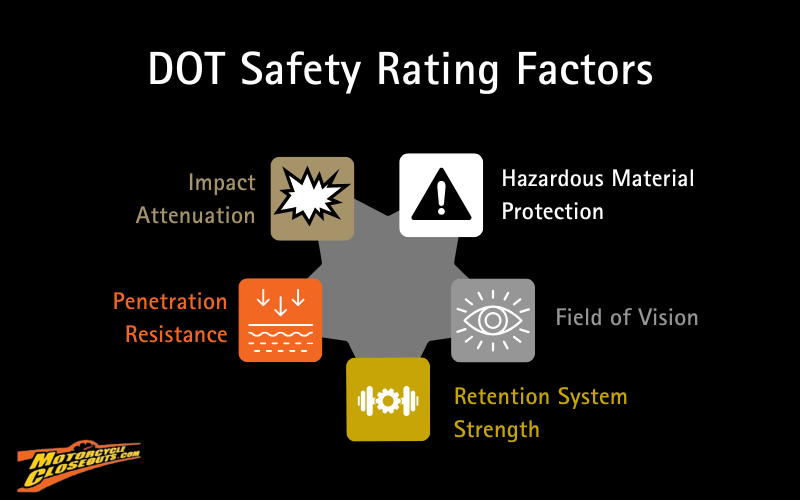
During the DOT safety rating evaluation, testing laboratories conduct a safety audit examining several critical factors:
- Impact attenuation: How well the helmet absorbs crash energy during roadside inspection simulations
- Penetration resistance: Whether objects can pierce through the helmet
- Retention system strength: How securely the chin strap keeps the helmet in place
- Field of vision: Ensuring the helmet design doesn't obstruct rider visibility
- Hazardous material protection: How well the helmet shields against road debris exposure
A critical violation of any requirements can result in an unsatisfactory rating for the helmet model. Manufacturers must take immediate corrective action when safety violations are discovered.
DOT-Certified Helmets (Satisfactory Rating)
A DOT-certified helmet has met or exceeded minimum safety standards established by federal safety regulations. This is equivalent to a satisfactory rating in the commercial vehicle world. The DOT certification appears as a sticker on the back of the helmet with the letters "DOT." These helmets feature a durable outer shell, impact-absorbing liner, comfortable padding, and a secure retention system
Novelty Helmets (Unsatisfactory Rating)
Unfortunately, some products marketed as "motorcycle helmets" don't meet any safety standards – the equivalent of an unsatisfactory safety rating. These novelty items lack proper safety features and offer minimal protection in a crash. They don't carry a legitimate DOT safety rating and are illegal for use on public roads. Using a non-rated helmet puts riders at significant risk and may result in traffic citations.
The DOT doesn't test every helmet before it reaches the market. Instead, manufacturers self-certify that their products meet standards, similar to a company snapshot declaration. The DOT then conducts random sampling and testing to verify compliance. If testing reveals a helmet doesn't meet safety standards despite carrying a DOT label, the manufacturer must take immediate corrective action, including a safety audit and potential recalls.
The Helmet Testing and Certification Process
The process of earning a DOT safety rating involves rigorous testing procedures designed to simulate real-world accident scenarios, comparable to how a DOT compliance review evaluates safety management practices.
Laboratory Testing and Safety Audit
DOT compliance testing occurs in specialized laboratories where technicians subject helmets to standardized tests:
- Impact testing: Helmets are dropped from a predetermined height onto various shaped anvils. Sensors measure the acceleration forces that would reach the rider's head. This is comparable to how a motor carrier's vehicle inspection ensures safety equipment functions properly.
- Penetration testing: A pointed striker is dropped onto the helmet to ensure it doesn't penetrate through to the headform inside. This simulates protection against road debris
- Retention system testing: The helmet's chin strap is tested to ensure it remains secure during impact
- Environmental conditioning: Before testing, helmets are exposed to various environmental conditions to ensure they maintain their protective capabilities
Critical violations result in an unsatisfactory rating. Manufacturers must address these issues before helmets can receive DOT safety rating approval.
To ensure compliance, NHTSA randomly purchases and tests helmets from the marketplace. If they find helmets that don't meet safety standards despite carrying the DOT label, the manufacturer must take immediate corrective action, which may include stopping production, issuing recalls, facing fines, and implementing new quality control measures.

Other Important Safety Ratings for Motorcycle Gear
While the DOT rating is mandatory for all motorcycle helmets sold for road use in the United States, several other safety ratings provide additional assurance:
Snell Memorial Foundation
The Snell Memorial Foundation's standards are generally more rigorous than DOT requirements, with stricter impact testing and additional safety criteria. A helmet with both DOT and Snell certifications typically offers superior protection. Snell updates their standards periodically.
ECE Rating
The Economic Commission for Europe (ECE) 22.05 standard is recognized in over 50 countries. Many premium helmet manufacturers design their products to meet both DOT and ECE standards. The ECE testing process differs from DOT in that it requires pre-market approval rather than self-certification.
Insurance Considerations
Insurance companies often consider the type of helmet you wear when determining insurance premiums, just as they do with motor carriers based on their safety ratings. Wearing a helmet with multiple certifications may help reduce your costs while providing better protection.
How Motorcycle Closeouts Prioritizes Safety
At Motorcycle Closeouts, we prioritize rider safety by offering an extensive selection of DOT-certified helmets and men's and women’s protective gear from top manufacturers, all at significant discounts. Unlike some retailers who might compromise on quality, every helmet we sell meets or exceeds DOT standards and carries the same manufacturer warranty as full-price merchandise, ensuring proper regulatory compliance.
How Motorcycle Closeouts Works
Our business model is simple but powerful: we acquire closeout items (not blemished or defective products) and pass the savings directly to you. These are the same high-quality products with all the safety features you'd find at your local motorcycle dealership, just at 30-50% off retail prices. Whether you're looking for helmets with advanced safety features, or other protective equipment, you'll find trusted brands that don't compromise on conditional rating requirements or safety standards.
Don’t Sacrifice Safety for Price with Motorcycle Closeouts
Safety ratings serve one critical purpose, keeping riders protected in case of an accident. At Motorcycle Closeouts, we believe you shouldn't have to choose between safety and savings. Our discounted, high-quality gear helps you stay protected without the premium price tag, making regulatory compliance and personal safety accessible to all riders.
Next time you're shopping for a motorcycle helmet, remember that the DOT safety rating isn't just a legal requirement, it's a vital indicator of a helmet's ability to protect you from critical violations of safety. Visit motorcyclecloseouts.com to discover how we can help you gear up safely without breaking the bank.
Explore Popular Articles

The Best Motorcycle Helmet Audio System
Short Answer: The best motorcycle helmet audio system depends on how you ride. Bluetooth communicati...
How to Clean Motorcycle Helmet Pads
Keeping your helmet pads clean comes down to a few basics: warm water, mild soap, and a little time....

How to Winterize Your Motorcycle; Motorcycle Closeouts
Short Answer: Proper winter motorcycle storage starts with a few key steps: fill your gas tank and a...

What to Know When Riding in Cold Weather
Short Answer: Riding in cold weather takes extra preparation, the right gear, and awareness of how c...

Your Guide to Motorcycle & Motocross Eye Protection
Motorcycle riding offers a completely different experience than driving a car. Riders stay much more...

Motocross Helmet: Buyer's Guide
Safety Standards and Certifications That Matter MIPS Technology: Better Brain Protection Helmet Co...